フェナキストスコープ、テキスト|サイズ可変
紙、木材、鏡、カメラ、液晶モニター
Phenakistoscope, Text | Variable size
Paper, wood, mirror, camera, LCD monitor



コンセプト
私は躁な傾向がある。学生時代は自覚がなかったのだが、周りから散々指摘されて最近になって自覚した。それによってうまくいっていたことが多々あったし、一方で散々迷惑もかけてきた。躁状態によって凄まじいスピードの活動量を行い、体力が底を尽きると、長期間ガクッと何もできなくなる。外に出ることや対外的な活動が苦手だという自覚を持っているにも関わらず、普段から様々な人と会い、外に出かけ、活動する。寝ることも1日の疲労で気絶する時に眠ることができるので、学生時代以降、時間も揃ったことがない。こうした極端な双極性はしばしば躁鬱と形容されるが、それは単に、生活する上での身体のリズムの振れ幅が大きいということだ。人間は恒温動物であるから、常に一定のリズムで活動を持続させるが、一方で変温動物は冬になると穴蔵に潜って冬眠を行う。変温動物は気温に合わせた身体の振り幅が広い。私は、人間の躁によって限界を迎えた鬱状態が、リズムという観点でみれば変温動物における冬眠状態と同じなのではないかと思うようになった。死んでしまうリスクを孕みながらも春をじっと待つ。
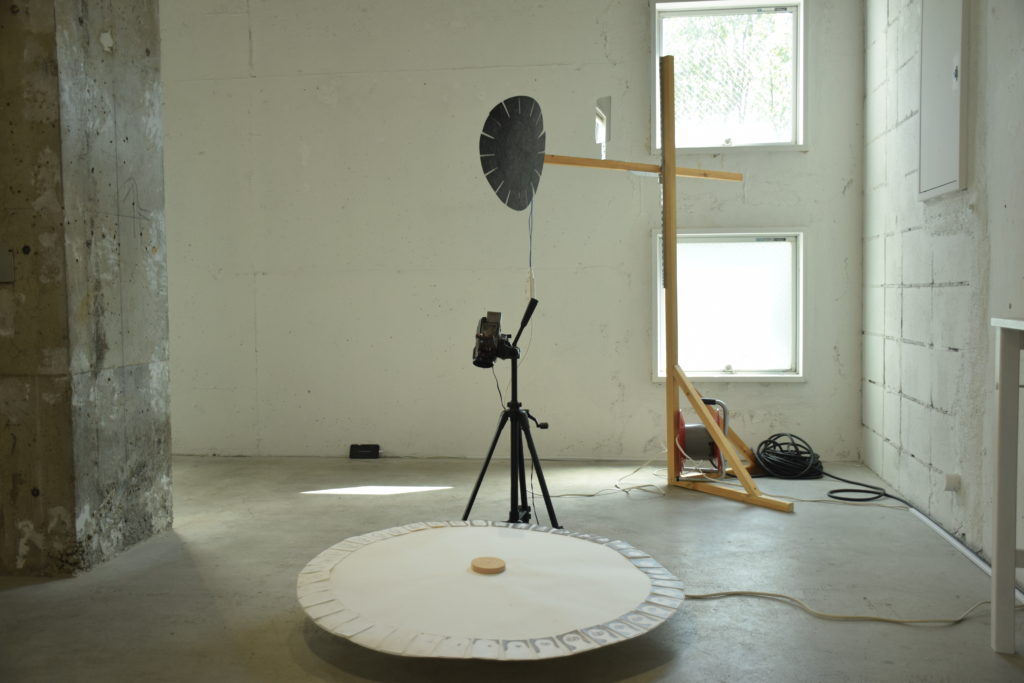
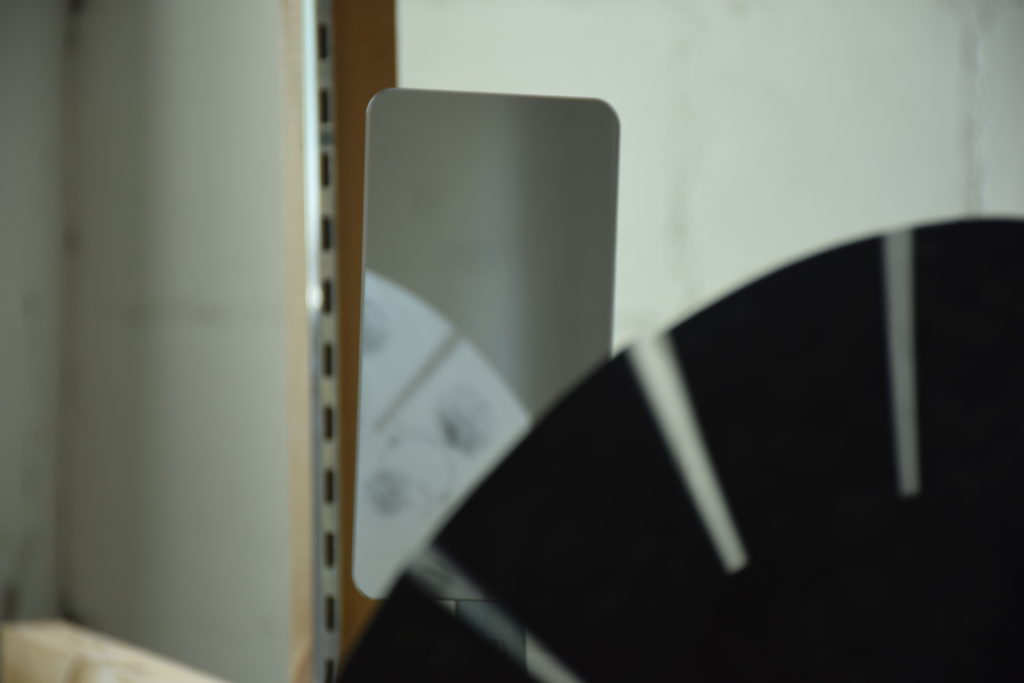
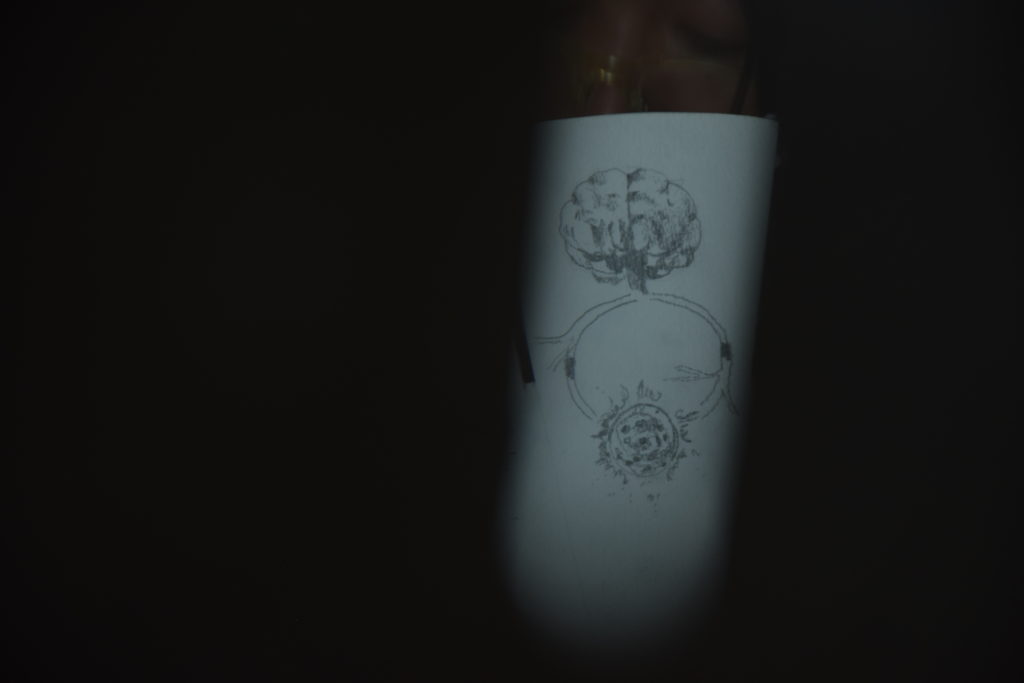
この作品では、フェナキストスコープという、おそらく最古のアニメーション技術を用いて二つのアニメーションを作成している。一つは人間の鬱状態の姿から動物の冬眠する姿に変身するアニメーション、もう一つは人間の躁状態を表す、脳の細胞に刺激が行き渡る様を反復させたアニメーションである。一つ目はビデオカメラのリアルタイム撮影によって画面越しに映像を見ることができそれを見るためには四足歩行のように四つん這いにならなければ見ることが難しい。二つ目のアニメーションは古典的な方法に習って、鏡ごしに覗くことで動くさまを見ることができ、また自分の身長に合わせて高さ調節をしながら二足歩行を前提とした姿勢で鑑賞することができる。
モニターには、私が日常生活で話した様々な言葉を引用し、ランダムに流している。
Concept
I have a tendency toward mania. I wasn’t aware of it during my student days, but after being repeatedly pointed out by others, I’ve recently become conscious of it. Because of this, many things went well for me, but on the other hand, I’ve also caused a lot of trouble. When in a manic state, I engage in an incredible amount of activity at a tremendous speed. Once my physical strength is completely depleted, I become utterly unable to do anything for a long period. Despite being aware that I dislike going out and external activities, I routinely meet various people, go out, and engage in activities. Sleep comes only when exhaustion knocks me out, so my schedule has never been consistent since my student days. This extreme bipolarity is often described as manic-depressive, but it simply means my body’s rhythms swing wildly in daily life. Humans are warm-blooded animals, so we maintain constant rhythms to sustain activity. Cold-blooded animals, however, burrow into dens and hibernate during winter. Their bodies have a wide range of fluctuation to match the temperature. I began to think that the depressive state reached by a human’s mania, viewed from the perspective of rhythm, might be the same as the hibernation state in cold-blooded animals. Waiting patiently for spring, while carrying the risk of death.
This work employs the phenakistoscope, arguably the oldest animation technique, to create two animations. One depicts a human in a depressive state transforming into an animal in hibernation. The other represents a human in a manic state, showing repeated stimulation spreading through brain cells. The first animation can be viewed in real-time through a video camera feed, but viewing it requires crawling on all fours, much like quadrupedal movement. The second animation follows classical methods: it can be viewed by peering through a mirror to see the motion, and it can be viewed while adjusting the height to match one’s own stature, adopting a posture based on bipedal walking.
On the monitor, various words I spoke in daily life are quoted and displayed randomly.